Can a Will Be Challenged After Death? Legal Rules and Under Indian Law
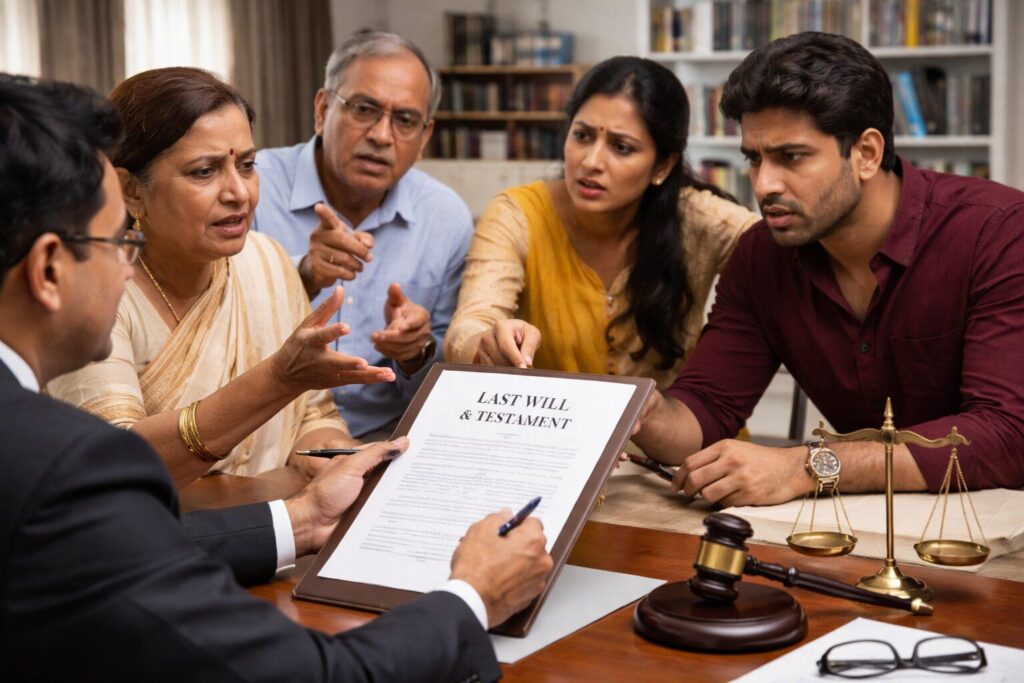
Can a Will Be Challenged After Death Under Indian Law?
Yes, a will can be challenged after the death of the testator under Indian law, but only on valid legal grounds. The law relating to wills is primarily governed by the Indian Succession Act 1925, which sets out how a will must be executed to be legally valid.
If a will appears to have been properly signed and witnessed, courts usually begin with the presumption that it is valid. However, that presumption can be questioned if an interested person raises legitimate doubts supported by facts and evidence.
This means a will cannot be challenged merely because someone feels the distribution is unfair. The challenge must be based on a legal defect, improper execution, or suspicious circumstances surrounding the document.
Also Read – How to write a will ?
Who Can Challenge a Will?
Not every person has the legal right to challenge a will. In most cases, only those who have a direct legal or financial interest in the estate are allowed to question the validity of the document.
Courts generally examine whether the person filing the objection is genuinely affected by the outcome of the will before admitting the challenge.
Typically, the following persons may have the right to challenge a will:
- Legal heirs such as spouse, children, or parents
- Beneficiaries under a previous will
- Persons who were financially dependent on the deceased
- Individuals who may inherit if the will is declared invalid
Legal Grounds to Challenge a Will
A will may be challenged only on recognised legal grounds. Courts do not entertain objections based on emotion, disappointment, or family disagreement alone. The person raising the challenge must show a legal reason supported by relevant evidence.
The table below explains the most common legal grounds on which a will may be contested in India.
| Legal Ground | What It Means | Why It Matters |
|---|---|---|
| Lack of testamentary capacity | The person making the will was not of sound mind at the time of execution. | A will is valid only if the testator understood the nature of the document, the extent of assets, and the effect of distribution. |
| Undue influence or coercion | The will was made because of pressure, manipulation, or forced influence by another person. | A will must reflect the free and voluntary intention of the testator. |
| Fraud or forgery | The document was forged, altered, or obtained through deception. | A forged or fraudulently created will has no legal validity. |
| Improper execution | The will was not signed or attested in the manner required by law. | Non compliance with statutory formalities can make the will unenforceable. |
| Suspicious circumstances | The facts surrounding the will appear unusual or doubtful. | Courts closely examine cases where natural heirs are excluded, the distribution is unusual, or a beneficiary played a major role in preparing the will. |
Time Limit to Challenge a Will in India
There is no single fixed limitation period that applies to every will dispute in India. The timeline often depends on the type of legal proceeding involved, such as probate proceedings or a civil dispute relating to inheritance rights.
In general, objections should be raised within a reasonable time after the will becomes known to the concerned party. If a person delays without a proper explanation, the delay may weaken the challenge.
Where probate proceedings are involved, objections are usually filed during the probate process itself. Once probate has been granted, it becomes more difficult to challenge the will unless fraud, forgery, or serious irregularity can be shown.
Legal Process to Challenge a Will
Challenging a will is a formal legal process. It cannot be done through verbal objections, family discussions, or private claims alone. The challenge must be brought before the appropriate civil court, usually during probate proceedings or through a civil suit connected with inheritance rights.
The process generally starts when an interested person files a formal objection or caveat before the court. The court then examines whether the objection discloses valid legal grounds. If it does, the court proceeds to examine the will, the evidence, and the surrounding facts in detail.
The legal process usually involves the following stages:
- Filing a formal objection or caveat, the person challenging the will must clearly state the legal grounds such as fraud, undue influence, suspicious circumstances, or improper execution.
- Submission of supporting evidence, the challenger must produce documents or testimony that support the objection, including medical records, previous wills, financial records, or proof of suspicious conduct.
- Examination of attesting witnesses, the court may call the witnesses who signed the will to verify whether it was properly executed and whether the testator signed it voluntarily.
- Verification of mental capacity, if soundness of mind is questioned, the court may review medical documents or testimony to determine the mental condition of the testator at the time of execution.
- Court evaluation of suspicious circumstances, the court may examine unusual exclusion of heirs, sudden changes in distribution, or a beneficiary’s involvement in drafting the will.
- Burden of proof assessment, the person challenging the will must initially establish the grounds of challenge, but if suspicious circumstances are shown, the burden may shift to the person relying on the will to prove its validity.
After considering the material on record, the court decides whether the will should be accepted as valid or rejected. The length of the process depends on the complexity of the dispute and the quality of evidence available.
How to Prevent a Will from Being Challenged
It may not be possible to remove every possibility of a dispute, but certain precautions can significantly reduce the risk of a challenge and make the will stronger in law.
Some of the most important safeguards include:
- Ensure proper drafting of the will, the language should be clear, direct, and free from ambiguity. The assets and beneficiaries should be properly identified.
- Follow correct execution formalities, the will must be signed by the testator and attested by at least two witnesses as required by law.
- Obtain a medical fitness certificate where appropriate, this is especially useful if the testator is elderly, ill, or likely to face future allegations regarding mental capacity.
- Use independent witnesses, neutral witnesses reduce the chance of allegations that a beneficiary influenced the making of the will.
- Consider registration of the will, although registration is not compulsory, it can improve evidentiary value and reduce allegations of forgery.
- Maintain transparency in distribution, if natural heirs are excluded or given unequal shares, it helps to record reasons clearly.
- Update the will periodically, reviewing the will after major life changes helps maintain legal clarity and relevance.
- Seek professional legal assistance, structured drafting and review can reduce the risk of technical defects and future disputes.
About WillJini
Willjini helps individuals and families prepare legally structured Wills and other estate planning documents with clarity and proper documentation. Its services are designed to reduce the risk of disputes by ensuring that important legal formalities are properly addressed. In matters where questions may arise about validity, execution, or inheritance, professional drafting support can make the documentation stronger and easier to defend if challenged later.
Conclusion
Yes, a will can be challenged after death under Indian law, but only on valid legal grounds. Courts do not set aside a will merely because a person is unhappy with the way assets have been distributed. A successful challenge usually requires proof of factors such as lack of testamentary capacity, undue influence, fraud, forgery, improper execution, or suspicious circumstances.
For families, the best way to reduce future conflict is to ensure that the will is drafted properly, executed correctly, and supported by clear documentation. A carefully prepared will is far more likely to be accepted by the court and far less likely to be questioned later.
FAQs
Who has the legal right to challenge a will in India?
Usually, only persons with a direct legal or financial interest in the estate, such as legal heirs, beneficiaries, or dependents, can challenge a will. Unrelated third parties generally cannot do so without a valid interest.
Can a registered will also be challenged in court?
Yes, a registered will can still be challenged on grounds such as fraud, coercion, suspicious circumstances, or improper execution. Registration may strengthen the document, but it does not make it immune from challenge.
Can a will be challenged if a legal heir is excluded?
Yes, a legal heir may challenge the will if there are valid legal grounds. However, exclusion by itself is not enough unless it is linked to suspicious circumstances or some other legal defect.
How difficult is it to successfully challenge a will?
It is generally difficult because courts usually presume that a properly executed will is valid. The person challenging the will must bring strong evidence to support the objection.
What happens if a will is successfully challenged?
If the will is declared invalid, the estate may be distributed according to an earlier valid will. If there is no earlier valid will, the property may pass according to intestate succession laws.
How can families reduce the risk of disputes over a will?
Families can reduce disputes by ensuring proper drafting, correct witnessing, clear asset details, and legally compliant execution. Professional drafting support can also help reduce technical mistakes.
Does proper estate planning help avoid will challenges?
Yes, proper estate planning helps reduce confusion and the chance of disputes. A clearly drafted and legally compliant will is usually easier to defend if questioned later.
Other articles for you