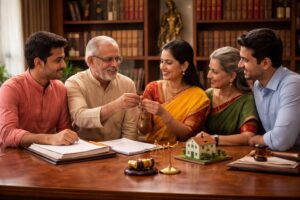


Special Marriage Act Explained: Property and Succession Rules

What is the Special Marriage Act
The Special Marriage Act 1954 is a civil marriage law enacted by the Indian Parliament that allows any two individuals to marry regardless of their religion,
caste, or faith. Unlike religious marriage laws that apply only to specific communities, this Act provides a secular framework for marriage that applies uniformly
across India.
The Act was created to address a fundamental need: allowing Indians from different religions or those who prefer a civil ceremony to marry without either party
converting their faith. Before this law existed, interfaith couples often faced significant legal and social barriers. The Special Marriage Act 1954 removed these
obstacles by creating a separate, religion-neutral path to legal marriage.
How is the Special Marriage Act different from personal law marriages?
This distinction is fundamental to understanding your rights.
| Factor | Personal law marriage (HMA / Muslim law / Christian law etc.) | Special Marriage Act marriage |
|---|---|---|
| Marriage framework | Religious, community based | Civil, religion neutral |
| Marriage authority | Priest, Qazi, Church etc. | Marriage Officer (legal registration) |
| Succession rules | Governed by religion based succession law | Generally governed by Indian Succession Act (Section 21) |
| Gender equality in inheritance | Depends on law (varies across communities) | Equal inheritance for sons and daughters under ISA framework |
| Interfaith succession disputes | More common due to confusion of applicable law | More clarity due to civil framework |
What are the property rights under the Special Marriage Act?
- Marriage under the Special Marriage Act, 1954 does not automatically create joint ownership of property.
- The law follows the principle of separate property ownership, meaning marriage does not merge assets.
- Any property owned by a spouse before marriage remains that spouse’s individual property even after marriage.
- Property purchased after marriage is owned by the person whose name appears on the title/registration documents.
- Even if one spouse financially contributes (for example, paying EMIs), it does not automatically create ownership rights unless the name is added to the title deed.
- Spouses may still have financial/legal protection through maintenance, residence rights, or court settlements, but these are separate from ownership rights.
Rights and protections available to the wife
Even if property is not jointly owned, wives are protected through multiple legal rights under matrimonial laws and allied laws.
- Right to maintenance during marriage: A wife may claim maintenance if financially dependent, depending on facts like income, lifestyle, needs, and husband’s capacity.
- Maintenance after separation/divorce: Courts may award monthly maintenance or lump sum support, especially where there is financial imbalance.
- Right to residence in shared household: In many cases, a wife cannot be forcibly removed from the matrimonial home without due process.
- Stridhan remains wife’s absolute property: Gifts, jewellery, cash, or assets given to her belong only to her, and cannot be legally claimed by the husband or in-laws.
- Protection against financial abandonment: Courts can structure interim financial relief and litigation expenses depending on circumstances.
- Joint assets are enforceable: If the wife’s name is on property/asset documentation, she has equal enforceable rights as co-owner.
What happens to property after divorce under Special Marriage Act
Divorce under the Special Marriage Act does not mean automatic 50-50 property division. In most cases, property stays with the person whose name is on the legal title.
However, courts can order maintenance or lump sum settlement to ensure fairness, especially if one spouse was financially dependent.
If property is jointly owned, the property can be
transferred,
divided, sold, or one spouse may buy out the other’s share.
Succession Rights under Special Marriage Act
If a person married under SMA dies, inheritance is generally governed by the Indian Succession Act 1925, not religious succession laws.
- This provides a secular and uniform inheritance system for the couple.
- If the person dies without a Will, intestate succession rules apply.
- The Indian Succession Act decides who gets what based on legal heir priority.
- The spouse gets priority, along with children and sometimes parents.
- The final share depends on who survives (spouse, children, parents).
- Sons and daughters inherit equally.
- There is no gender difference in inheritance shares.
- Parents may also inherit depending on whether children exist.
- The share changes based on the family members alive at the time of death.
- If a valid Will exists, the property is distributed as per the Will.
- The default succession rules apply only when there is no Will.
How does intestate succession work under Special Marriage Act
If a person married under the Special Marriage Act dies without a Will, their property is distributed as per the Indian Succession Act, 1925.
The division depends on which close family members are alive, mainly the spouse and children, and in some cases parents.
In most cases, if the deceased leaves behind a spouse and children, the spouse gets a fixed share and the remaining property is divided equally among all children
(sons and daughters get the same share). If there is no spouse, children inherit everything equally.
If there are no spouse and no children, then the property goes to other relatives in order of priority, like parents, siblings, and then more distant relatives.
Can you make a Will if married under Special Marriage Act
You can absolutely make a
Will
even if you are married under the Special Marriage Act. In fact, it is strongly recommended because the default succession rules apply only when a person dies without a Will.
A valid Will allows you to decide who will inherit your property, such as your spouse, children, parents, or even friends or charities, and in whatever proportion you choose.
To be legally valid, the Will must be made by a person who is 18 years or older, of sound mind, in writing, signed by the testator, and attested by two witnesses
(who should not be beneficiaries). You can revise or cancel your Will anytime during your lifetime, so it should be reviewed after major life changes like marriage,
having children, property purchase, or divorce.
What are children’s rights under Special Marriage Act
- Children from this marriage are legally valid (legitimate).
- Sons and daughters get equal rights in inheritance.
- While parents are alive, children cannot claim ownership on parents’ property.
- Children get their share only after a parent dies.
- If the parent has made a Will, property will be divided as per the Will.
- Adopted children also get equal rights, same as biological children.
- Children from a previous marriage still have inheritance rights.
- If children are minors, a guardian manages the property till they turn 18.
How to protect property rights in Special Marriage Act marriages
While the Special Marriage Act provides a clear legal framework, proactive planning strengthens financial security for both spouses.
Several strategies can help protect property rights and prevent future disputes.
- Make Wills for both spouses: A Will ensures your property goes to the intended person and avoids family disputes after death.
- Structure ownership correctly: If you want equal rights, buy assets jointly or add your spouse’s name in the title deed.
- Keep proper documentation: Maintain sale deeds, payment proofs, bank statements, and agreements to prove ownership and contributions.
- Update nominees regularly: Nomination helps smooth transfer of funds, but should match your succession plan and Will.
- Be cautious with prenups/postnups: These agreements are not fully enforceable in India, but can still support your intent in disputes if fair and reasonable.
Common Legal Disputes in Special Marriage Act Marriages
- Property division during divorce: Many spouses assume equal division, even if the property is in one spouse’s name. This mismatch often leads to disputes and long litigation.
- Contribution without ownership documentation: If one spouse paid EMIs or contributed financially but name is missing on documents, ownership claims become difficult. These cases usually turn into maintenance and compensation fights.
- Succession disputes with in-laws / extended family: After death, relatives may challenge the spouse’s inheritance rights, especially in interfaith marriages. Families sometimes try to apply religious succession laws instead of the Indian Succession Act.
- Challenges on marriage validity: In some disputes, in-laws claim the SMA marriage was not properly solemnised or registered. This is often raised to weaken the spouse’s inheritance rights.
- Maintenance and alimony disputes: Arguments over the amount of maintenance can continue for years due to lifestyle and income assessments.
- Will validity challenges: Family members may allege coercion, fraud, lack of mental capacity, or forged signatures. Such cases can delay settlement of the estate for a long time.
- Joint property disputes: When property is jointly purchased but contributions are unclear, disputes arise over who paid more and who deserves a higher share.
- Foreign spouse inheritance disputes: In some families, inheritance is challenged simply because the spouse is a foreign national. Though legally allowed, emotional resistance often turns into legal objections.
Special Marriage Act vs Hindu Marriage Act succession rules
Final thoughts
The Special Marriage Act, 1954 offers a clear and secular framework for marriage, especially useful for interfaith couples.
Property ownership generally remains separate unless jointly registered, and succession is usually governed by the Indian Succession Act,
where sons and daughters inherit equally.
To avoid disputes and ensure smooth inheritance, it is best to do proactive planning through Wills, proper ownership documentation, and updated nominations.
Understanding these rules early helps protect your family’s financial future and prevents legal complications later.
About Willjini
WillJini specializes in succession planning, estate management, and property rights guidance for families
married under the Special Marriage Act. Whether you need help drafting Wills that comply with the Indian Succession Act, navigating property disputes, or understanding
your inheritance rights, their legal experts provide comprehensive support.
Contact WillJini at +91 8767404044 / 9321671899, email
support@willjini.com,
or visit www.willjini.com for personalized legal assistance tailored to your unique situation.
FAQs
1) What comes under the Special Marriage Act?
The Special Marriage Act, 1954 covers civil marriages that are registered legally through a Marriage Officer, without following any religion-based rituals.
It includes rules related to notice of intended marriage, objections, registration process, witnesses, and legal validity of marriage, along with provisions related to
divorce, judicial separation, and succession linkage (Section 21) in applicable cases.
2) What is the difference between Hindu Marriage Act and Special Marriage Act?
The Hindu Marriage Act applies only to Hindus, Sikhs, Jains, and Buddhists and is governed by Hindu personal law customs. The Special Marriage Act is a secular law that
allows marriage between any two individuals, including interfaith couples, through a civil registration process. Another key difference is that succession rules under SMA
can be governed by the Indian Succession Act, while Hindu Marriage Act marriages generally follow the Hindu Succession Act.
3) Is the Special Marriage Act still valid?
Yes, the Special Marriage Act, 1954 is fully valid and in force in India. It is commonly used today for interfaith marriages, intercaste marriages, and court marriages,
and continues to be recognised by Indian courts and legal authorities.
4) Can Hindus marry under the Special Marriage Act?
Yes, Hindus can marry under the Special Marriage Act. Many Hindu couples choose SMA when they prefer a civil court marriage instead of religious ceremonies, or when they
want a uniform legal framework. However, in some cases (for example, where both parties are Hindus), the succession impact may differ due to legal exceptions under the Act.
Other articles for you